
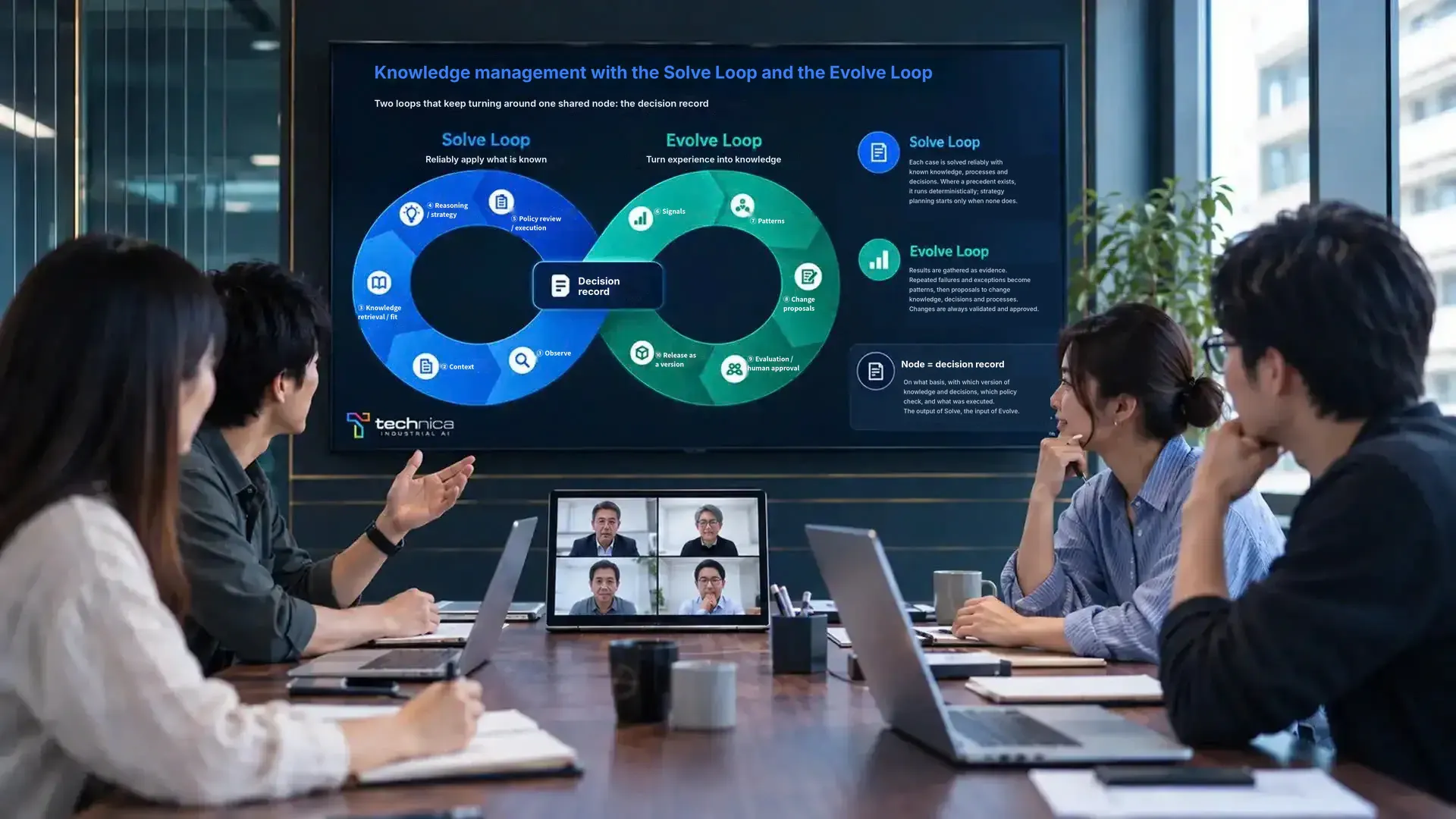
Engineering organizations hold valuable knowledge in design documents, specifications, test records, verification reports, and failure analyses. Much of it remains scattered across PDFs, Office files, scanned documents, and document management systems, making it difficult to reuse the reasoning behind decisions.
This solution combines multimodal document understanding with structured engineering knowledge. By linking documents, equipment, components, specifications, test results, failure patterns, and corrective actions, it helps teams retrieve evidence and reuse technical experience across design, verification, maintenance, and quality processes.
Technical documents are available, but the knowledge within them is hard to reuse.
- Information is distributed across systems
Specifications, drawings, test results, and quality records are stored in different locations, making cross-document investigation time-consuming. - Critical meaning goes beyond text
Tables, formulas, graphs, and engineering drawings contain relationships that conventional full-text search or OCR alone may miss. - Design rationale and experience are easily lost
Reasons for specification changes, failure investigations, and corrective actions can remain buried in reports or individual experience. - Relationships are difficult to trace
Teams need to connect requirements, specifications, revisions, tests, and incidents to understand why a decision was made.
Make technical information searchable in its engineering context.
- Understand complex technical documents
Combine visual document analysis and text recognition to extract information from tables, formulas, charts and drawings as well as written text. - Structure information around engineering entities
Organize equipment, parts, specifications, design conditions, tests, symptoms, root causes, and countermeasures while retaining values, units, and references to the source. - Reuse lessons from failures and defects
Extract symptoms, operating conditions, investigation findings, corrective actions, and outcomes to support similar-case retrieval and root-cause analysis. - Connect knowledge through explicit relationships
Define and link the relationships between components, specifications, test results, failure modes and corrective actions so users can explore the context behind a search result. - Respect revisions, provenance, and access rights
Track document versions and available change history, link answers to supporting sources, and apply relevant project, role, or department permissions to retrieval.
Turn existing engineering records into a reusable knowledge resource.
- Faster technical investigation
Locate relevant specifications, designs, and test evidence across available sources.
- Better reuse of past cases
Use recorded failure patterns and corrective actions when investigating new issues.
- Preserved design rationale
Keep supporting evidence and available change history connected to technical decisions.
- Knowledge shared across teams
Make documented expertise easier to find, review, and apply.
- Value from existing systems
Build on existing documents and DMS investments rather than requiring all content to be recreated.
Preserve the reasoning, not just the documents.
Engineering knowledge becomes more valuable when teams can connect a conclusion to the specifications, evidence, and experience behind it. Technica AI helps organize these relationships so that existing technical assets support future design, troubleshooting, and verification work.