

Technical support for connected TV and telecom equipment often begins with vague symptoms that require several rounds of questioning and troubleshooting. Complex calls depend heavily on experienced operators, making service expansion difficult.
Over approximately one year of collaborative development, Technica AI combined the client’s standard operating procedures (SOPs), technical documentation, and past calls to support routine automation and operator assistance. The proposed operating model targets a 40–45% reduction in overall contact center workload, subject to validation in live operations.
Complex equipment creates complex customer conversations.
The service covers interconnected equipment such as televisions, receivers, remote controls, antennas, cables, and networking devices. A customer may report only that there is no picture or that something has stopped working.
Operators must ask targeted questions, guide customers through checks, interpret the answers, and choose an appropriate next step.
The more unusual the issue, the more often resolution depends on knowledge held by a small group of experienced operators.
Critical troubleshooting knowledge was difficult to scale.
Expert operators use judgment that goes beyond written manuals: which cause to investigate first, which information is missing, and when a standard procedure no longer applies.
Much of that knowledge exists only in conversations. Busy teams have little time to turn exceptional cases into reusable guidance.
This creates a bottleneck in training and escalation. Increasing the number of agents alone does not necessarily reproduce the judgment needed for difficult calls.
Combining SOPs, conversational context, and operational knowledge.
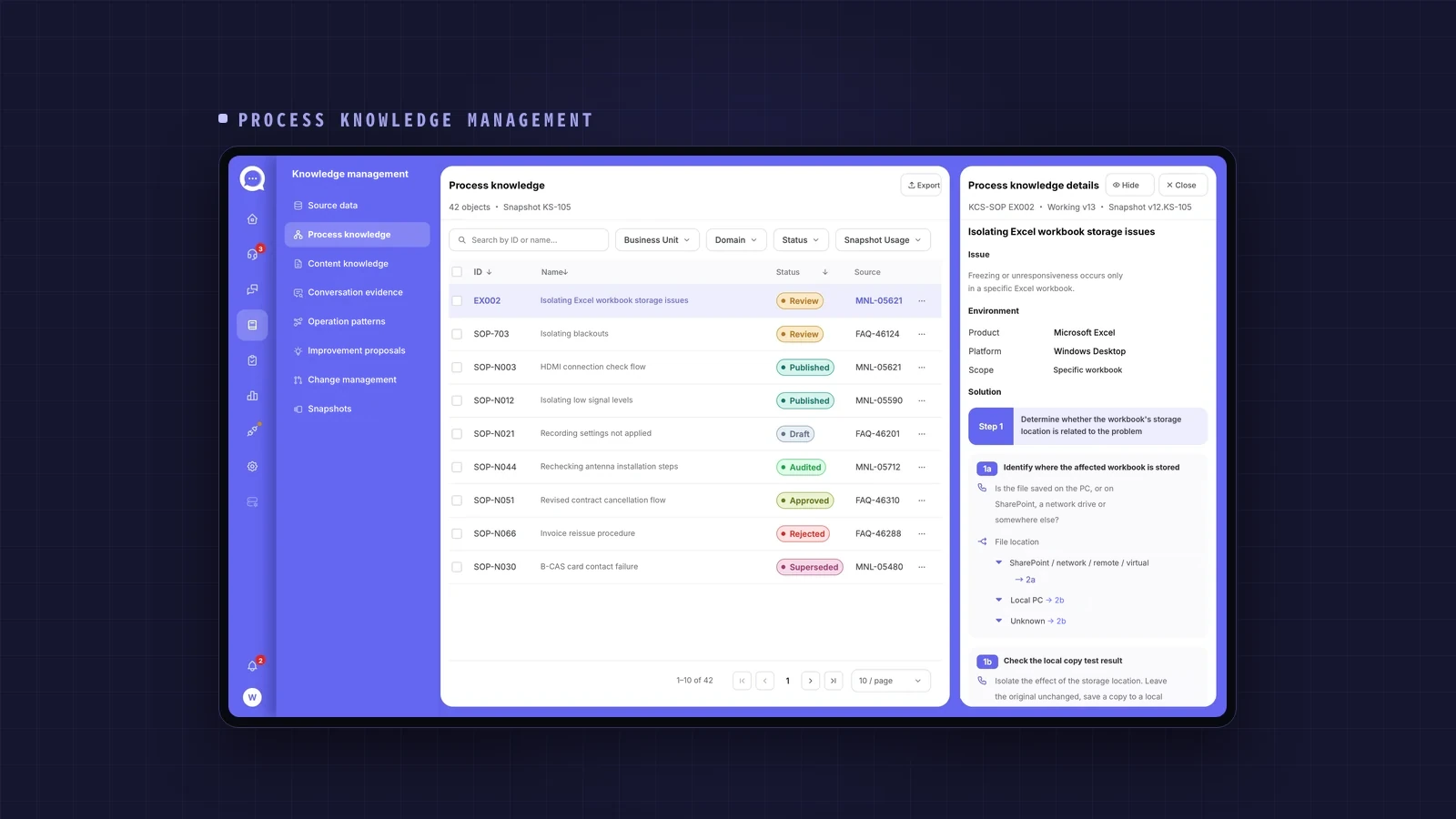
Technica AI developed a process-aware system that follows defined SOP steps for standard situations and retrieves technical information and past-case knowledge when additional context is needed.
A key design focus was extracting experienced operators’ decisions and exception-handling patterns from call records, then structuring that evidence for review and reuse.
The intended operating model allows routine, appropriately validated tasks to be automated while operators retain responsibility for exceptions and situations that exceed the approved automation scope.
A modeled 40–45% reduction in contact center workload.
The team iterated over approximately one year using actual SOPs, documents, call records, and evaluation cases to assess the feasibility of the combined approach.
Based on the planned division between routine automation and operator assistance, the project estimates that overall workload could be reduced by approximately 40–45%. This remains a projected benefit; a measured post-deployment reduction has not been established.
The approach also provides a process for reviewing and testing lessons from future calls before incorporating them into service guidance.
Less dependence on specialists, with human oversight preserved.
-
Broader access to expert knowledge
Troubleshooting context and exception patterns can support less experienced operators.
-
More consistent onboarding
Reviewed operational guidance can reduce reliance on informal, one-to-one knowledge transfer.
-
Controlled automation
Routine cases are candidates for automation; exceptions remain within human-led workflows.
-
Continuous knowledge improvement
New call evidence can be reviewed and incorporated into the knowledge base.
Scaling support by making expert judgment reusable.
The project illustrates how SOP-based control, contextual knowledge retrieval, and human handoff can work together to support more consistent troubleshooting and carefully expand automation.