
Address a concrete challenge
We work within each client’s business processes, data, and constraints, validating the technical approach against the requirements of the project.
Starting from the goals and constraints shared across an industry or business function, we combine AI technologies, business rules and existing systems—turning insights from our R&D and projects into approaches that fit the work.
Explore how AI applies across the enterprise—from engineering design and quality control to demand forecasting, sales and customer support.
Our designs cover the full path: data acquisition, integration with existing systems and alignment with the rules of each business function.
Project experience informs reusable approaches, while every deployment is adapted to the client’s requirements.
We work within each client’s business processes, data, and constraints, validating the technical approach against the requirements of the project.
Where appropriate, we turn common methods and technical components into repeatable solution patterns, while respecting confidentiality and intellectual property agreements.
Validated and broadly applicable capabilities may become standardized products, creating a stronger foundation for future implementations.
Turn design, specification and testing expertise into an asset for the next engineering decision.
Engineering knowledge is scattered across specifications, drawings, test records, and failure reports. Finding a document is often possible; recovering the evidence and reasoning behind a past technical decision is much harder.
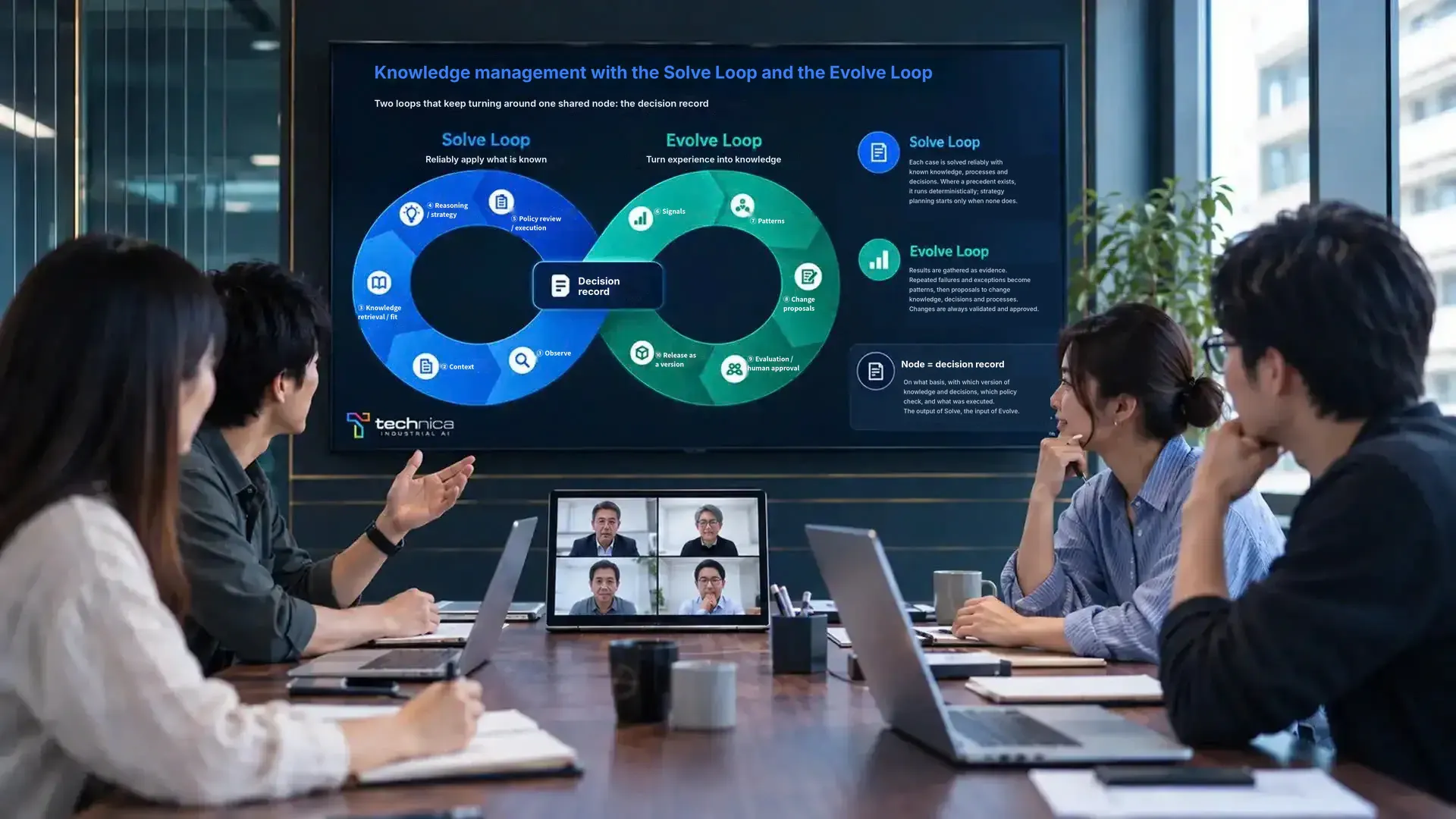
We combine multimodal document understanding, knowledge graphs, and context-aware retrieval to connect components, design conditions, test results, failure patterns, and corrective actions. Source references, version history, and access permissions help teams use information appropriately.
The platform builds on existing document repositories and helps engineers reuse technical experience in design, verification, troubleshooting, and maintenance—without requiring every source to be recreated.
Extract shapes, dimensions and part relationships from drawings to compare specifications, generate design proposals and check them against requirements.
P&IDs, mechanical drawings, and CAD models contain dimensions, equipment tags, connections, and specifications that often require manual interpretation. Converting these details into usable engineering data is time-consuming and prone to inconsistencies.
Our approach combines drawing recognition with structured information extraction, engineering specifications, and rule-based checks. Validated information can support equipment lists, design calculations, and parametric CAD workflows where the target environment permits.
We flag missing conditions, ambiguous drawing elements, and potential rule violations for engineer review. This reduces repetitive transcription and creates a controlled path from drawing analysis to design automation.
Detect anomalies, measure dimensions and assess images against your inspection criteria.
Manual inspection and dimensional measurement can be slow and inconsistent, especially for fine features and changing production conditions. Reliable automation depends on image quality, tolerances, equipment constraints, and available reference data.
We combine conventional image processing with deep learning to detect visible defects, identify unusual patterns, and measure critical dimensions against defined criteria. Imaging conditions, calibration, processing speed, and production-line integration are considered together.
Drawing on experience with fine-image measurement, we design inspection workflows for specific targets. Performance is assessed against agreed test data and acceptance criteria before automated decisions are deployed.
Forecast what is needed, where and when—and turn demand into operational plans.
Inventory, staffing, replenishment, and pricing decisions depend on demand that changes with seasons, markets, and customer behavior. Historical averages and manual planning alone may not respond quickly enough to those changes.
We combine operational data with relevant external signals to forecast demand at useful levels of detail. Optimization and scenario analysis help teams evaluate inventory, resource allocation, replenishment schedules, and pricing choices within business constraints.
Forecasts are reviewed against actual outcomes so models and decision rules can be refined. The goal is operational planning that responds to changing demand and business constraints.
Use customer, product and past-deal knowledge to sharpen proposals and inform sales decisions.
Sales teams spend substantial time gathering customer information, updating CRM records, and preparing proposals. When emails, meeting notes, documents, and opportunity histories are scattered, it becomes harder to identify the right next action.
The AI Sales Assistant brings these sources together to support opportunity summaries, proposal and email drafting, meeting preparation, and CRM updates. Historical deal signals can also inform pipeline analysis and revenue forecasts.
Sales professionals review customer communications and retain control of commercial decisions. The solution helps teams reuse sales knowledge, reduce administration, and focus more attention on customer conversations.
Turn service know-how into broader automation, with defined quality standards guiding each step.
Customer support involves more than answering questions. Teams must identify customer needs, verify information, follow procedures, and resolve exceptions while maintaining service quality as inquiry volumes grow.
Our solution combines real-time conversation context, enterprise knowledge retrieval, and SOP-guided workflows. It helps operators determine the next question or action, retrieve relevant information, and hand off cases that require human judgment.
Reviewed interactions can inform improvements to knowledge and procedures. Organizations can begin with operator assistance and expand automation to defined, lower-risk tasks as performance and controls are validated.
Tell us about your business challenge, existing systems, and objectives. We can discuss an approach that fits your requirements, whether it builds on an existing solution or calls for something new.
Discuss Your AI Requirements