
Customer support requires more than answering questions. Teams must understand the customer’s situation, verify information, follow business procedures, handle exceptions, and involve a human operator when necessary.
Our approach combines conversation context, enterprise knowledge and standard operating procedures (SOPs) to support operator assistance and a controlled progression toward automated inquiry handling. Automation expands where procedures and evaluation results support it, with human handoff for cases that need judgment.
Growing inquiry volumes put pressure on quality and consistency.
- Experienced operators hold valuable tacit knowledge
Skilled operators adapt their questions and decisions to each case, but this expertise is often difficult to document and share. - Complex inquiries require context and time
Operators need to verify information and consult manuals or previous cases while keeping track of the conversation. - A correct answer is not always a resolution
Service procedures can require identity checks, branching decisions, system actions, exception handling, and handoffs. - Frontline learning rarely reaches shared knowledge
New scenarios and exceptions take effort to review, document, and incorporate into operational procedures.
Support the entire service workflow—not only the answer.
- Maintain context throughout the conversation
Summarize relevant conversation history and track the customer’s objective, verified information, unresolved issues, and next steps to help operators stay oriented. - Recommend the next question or action
Use the customer’s statements and interaction history to identify missing information and suggest follow-up questions, relevant knowledge, or candidate actions. - Apply SOPs and manage exceptions
Guide defined processes using SOPs and business rules. When information is missing or a case falls outside the applicable procedure, clarify, escalate, or hand off according to the workflow. - Retrieve knowledge appropriate to the situation
Combine retrieval-augmented generation (RAG) with structured knowledge relationships to select relevant information based on the product, contract, verified context, and customer goal. - Turn reviewed interactions into reusable knowledge
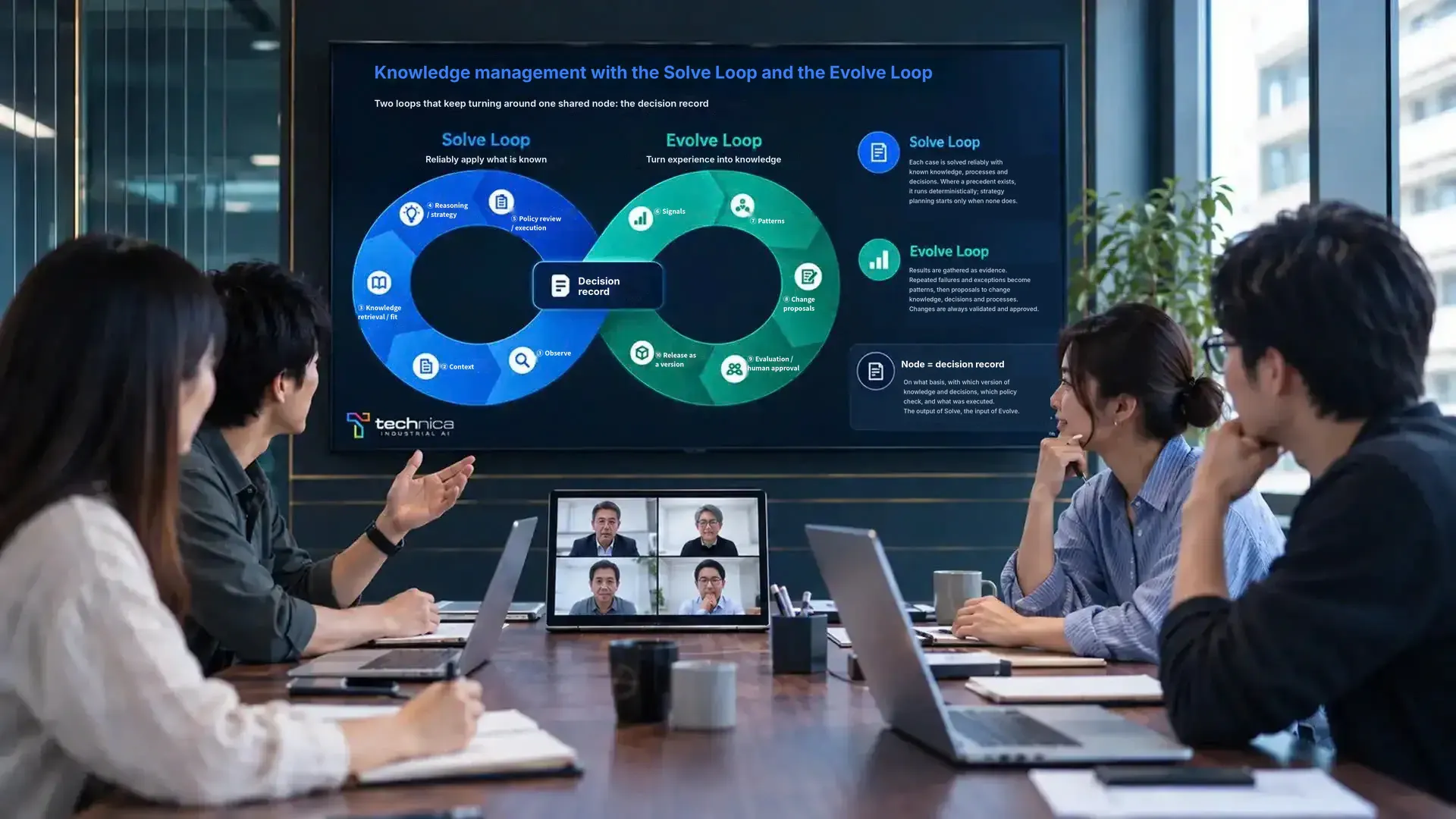
Identify recurring questions, exceptions, and successful resolutions in interaction records. Subject proposed updates to review and governance before adding them to shared knowledge or processes. - Expand automation in stages
Choose an initial scope—operator assistance or direct automation of bounded tasks—and expand where measured results and controls support it. Route cases needing additional judgment to human operators.
Increase support capacity while maintaining human oversight.
- Potentially shorter handling times
Help operators locate context, procedures, and relevant answers without repeated searches.
- Better support for first-contact resolution
Guide agents toward the required verification and resolution steps.
- More efficient onboarding
Make documented procedures and experienced operators’ knowledge available to newer team members.
- More consistent processes
Support the same approved procedures across teams and shifts.
- Controlled expansion of automation
Introduce automation progressively, based on measured performance and operational safeguards.
From answering questions to completing support workflows.
Effective customer support automation combines conversation understanding, reliable knowledge, operational rules, and clear exception handling. Technica AI helps organizations choose the right balance of assistance and direct automation, then validate it against service objectives and operating requirements.