

Variation in Appraisal Inputs
Appraisers may use different comparables and assumptions. Shared market evidence and explicit cost rules help teams review these differences while retaining expert judgment.
 Patent pending
Price Each Vehicle with
Market Insight.
AIVALUE combines vehicle condition with auction and used-car market data to estimate prices. It factors in selling costs and profit targets to calculate purchase limits and compare sales routes—bringing market evidence into appraisers’ purchasing and sales decisions.
A useful appraisal considers the vehicle’s attributes and condition, relevant market observations, and the intended sales route. Purchase limits also depend on costs and profit targets. AIVALUE brings these inputs together to support appraiser review.
Model, model code, trim, year, mileage, inspection grade, and damage information help distinguish vehicles. Physical inspection and missing details still require professional judgment.
Auction outcomes and used-car market observations inform estimates. Data coverage, quality, and market shifts affect how representative those estimates are.
Compare retail sale, auction resale, and parts recovery using expected proceeds, applicable costs, and configured profit targets.
A price estimate supports a decision; it does not guarantee the final transaction price or realized profit.
Reviewing numerous listings, comparing vehicle conditions, and tracking price changes can be time-consuming. Teams need consistent information and a clear way to identify vehicles that require closer review.
Appraisers may use different comparables and assumptions. Shared market evidence and explicit cost rules help teams review these differences while retaining expert judgment.
Market prices fluctuate constantly, influenced by factors such as overseas demand. Without a quick response to these changes, setting the right price becomes difficult.
AIVALUE supports screening, appraisal review, and pricing with AI estimates and configurable business rules. Coverage and workflows are established around the data and requirements of each deployment.
Appraise many vehicles against consistent criteria instead of relying on individual experience alone.
Estimate prices for supported listings in bulk and shortlist vehicles against configured purchase criteria. Teams review candidates before bidding or buying.
Market data is updated daily and valuation models are updated monthly. These schedules support regular refreshes; estimates may still lag abrupt changes or conditions not represented in the data.
AIVALUE uses more than 2 million records covering a six-month period and more than 50,000 prediction models, as of October 2026. Models use vehicle attributes and market data to estimate prices. These figures describe development scale; estimate quality is assessed separately.
← Scroll horizontally →
Screen supported listings on the vehicle list, then review price estimates, market observations, vehicle details, and purchase history on the detail screen. Final decisions also require the relevant inspections, costs, and business approvals.
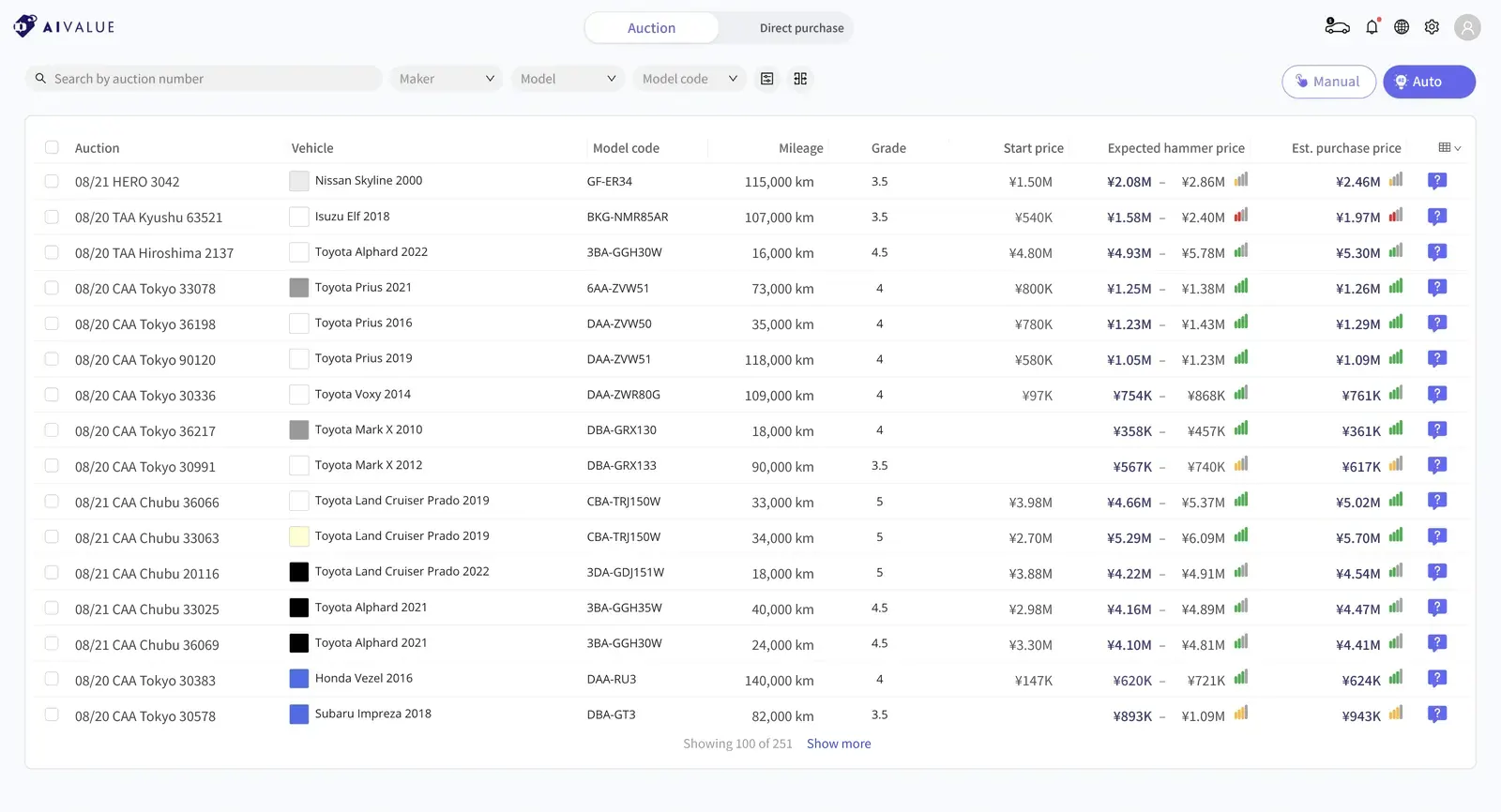
AIVALUE presents an estimated auction sale price range and a confidence indicator derived from simulation results. The indicator supports review; it is not presented as a calibrated probability of correctness or a guarantee that the final price will fall within the range.
Calculates a purchase limit from expected proceeds for the sales route, configured costs, and a target profit. It shortlists vehicles whose estimated auction price meets the purchase criteria; users can also add candidates manually. Estimated prices and margins do not guarantee a winning bid or realized profit.
Simply switch between “Auction” and “Direct purchase” to appraise vehicles you buy directly, for example at your store, with the same system.
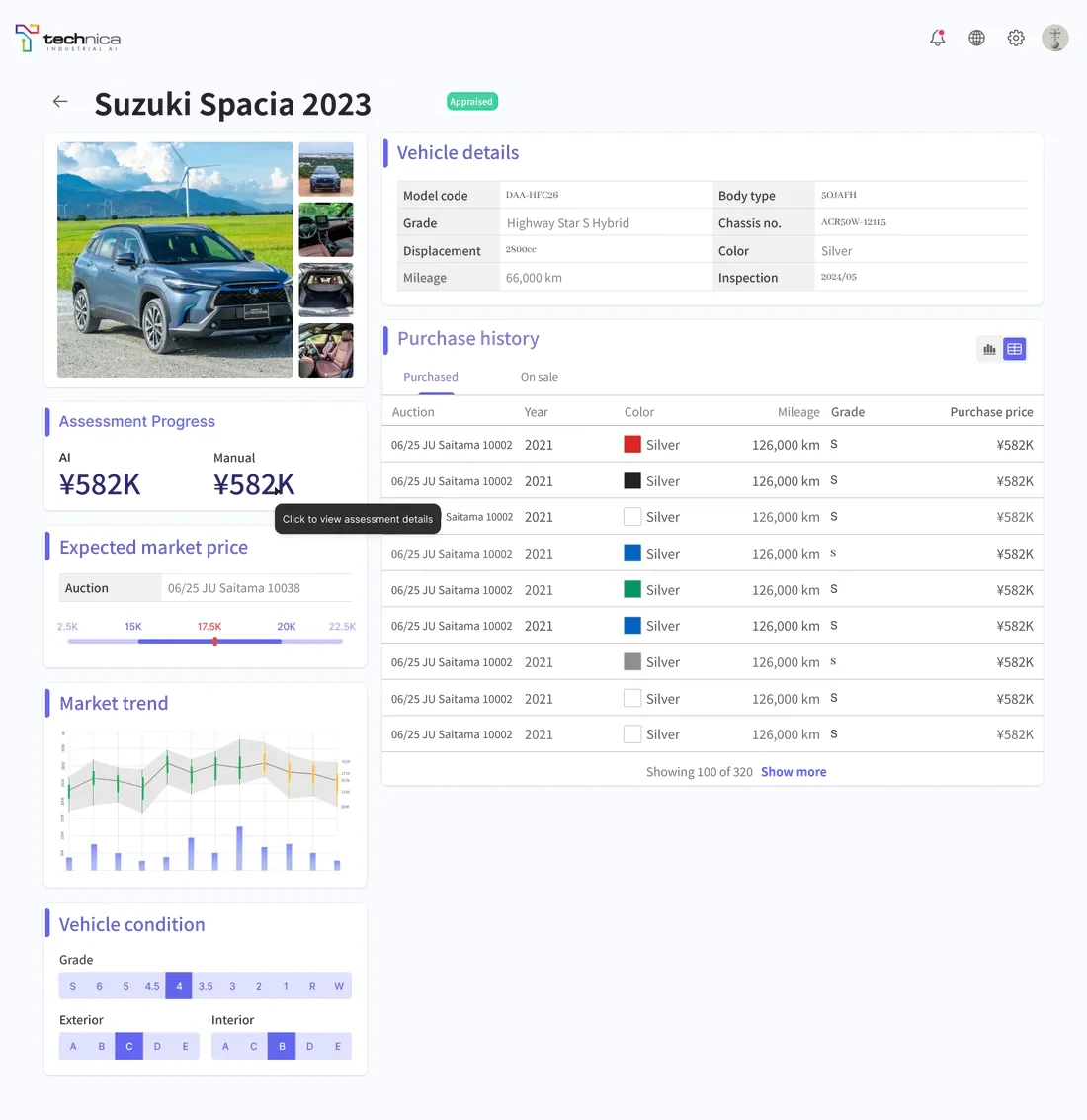
See the estimated market price, market trends, vehicle condition and parts information on a single screen.
Shows a list of vehicles of the same model you have purchased before, with their purchase prices, supporting decisions based on your own track record.
Appraisers can review and adjust estimates for vehicle condition, limited market evidence, and other exceptions. Their review brings inspection findings and business judgment into the appraisal decision.
AIVALUE supports vehicle purchasing, retail pricing, auction resale, leasing, export, and parts valuation. Data sources, cost assumptions, and business rules are configured for each customer; market coverage must match the intended use.
Bulk estimates and candidate lists can reduce repeated comparisons and help teams prioritize vehicles for review. Operational benefits depend on coverage, integration, and how the workflow is used.
Shared market estimates and cost rules give appraisers a common basis for discussion, while experienced staff review condition, assumptions, and exceptions.
Compare expected proceeds and costs for retail, auction resale, and parts recovery. Use a target profit to set purchase limits and review the trade-offs between routes. Actual profit depends on the purchase, processing costs, and final sale.
We also provide custom development tailored to your operations and integration with your existing systems.
AIVALUE uses vehicle attributes such as model, model code, trim, year, mileage, inspection grade, and damage information together with auction and used-car market data. As of October 2026, its data scope includes more than 2 million records covering six months, with more than 50,000 prediction models. Market data is updated daily and valuation models are updated monthly. Estimates support appraisal review and do not guarantee transaction prices.
Estimate quality depends on data coverage, vehicle condition, the relevance of comparable records, and market changes. The displayed confidence indicator is calculated from simulation results. It should be used as a review signal, not as a calibrated probability that an estimate is correct or a verified coverage level for the price range. Confirm the simulation scope and evaluation results for your vehicle mix during assessment.
Contact us to discuss a demo and your appraisal workflow. We review vehicle coverage, available data, cost and profit rules, and integration needs, then agree on an evaluation and deployment scope where appropriate.
The more than 50,000 prediction models are not a count of distinct vehicle models and do not establish universal coverage. Rare vehicles, older vehicles, unusual condition, or limited relevant market data may require additional review. Confirm coverage for your inventory and use appraiser adjustments where appropriate.
Yes. AIVALUE supports direct purchases and trade-ins as well as auction sourcing. Price estimates and purchase limits use available vehicle information and configured business rules. Review vehicle condition and missing information before making an offer.
Yes. Appraisers can review and manually adjust estimates, including for limited market data, damage, or other special conditions. Human review complements the AI estimate; final purchasing and pricing decisions remain with the responsible team.
Discuss your vehicle coverage, data sources, cost rules, and appraisal process.
We can demonstrate AIVALUE and assess how its estimates and review workflow fit your purchasing and sales decisions.