

Limited context can affect recognition
Processing isolated audio segments can make ambiguous words harder to resolve. Conversation context can help, but it does not eliminate transcription errors.
 SPEECH INTELLIGENCE
Make calls and meetings searchable, analyzable and reusable.
AIKNOW Voice handles live speech and recordings in Japanese and English. Context-aware transcription, speaker separation and topic organization make conversations easier to search and review. Configurable text masking targets selected personal information before the content is used in business knowledge applications.
A transcript is a starting point for using conversation data.
Noise, hesitations, homophones, technical terms, names, numbers and language switching can affect recognition and interpretation.
Processing isolated audio segments can make ambiguous words harder to resolve. Conversation context can help, but it does not eliminate transcription errors.
Preparing transcripts for analysis may involve separating speaker turns, handling fillers, cleaning up text and identifying relevant passages.
Long transcripts may need segmentation for retrieval-augmented generation (RAG). Conversations may also contain personal information that requires appropriate handling.
Automatic speech recognition (ASR) produces a transcript.
A workflow that stops at transcription may leave speaker organization, topic segmentation and personal-information handling to later stages. ASR systems vary in how they use context; this comparison describes workflow scope.
Transcription is part of the processing pipeline.
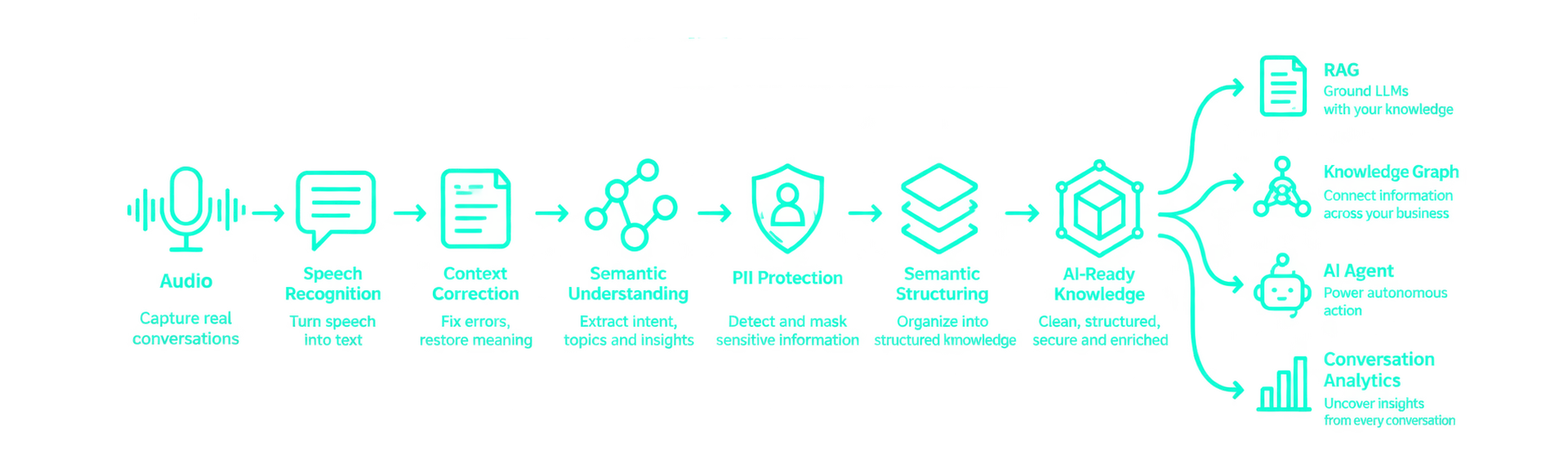
AIKNOW Voice analyzes conversation context, organizes speaker turns and topics, and structures content for enterprise knowledge applications.
← Scroll horizontally →
Uses conversation context to help resolve homophones and ambiguous wording, then produces a readable transcript. The original transcript is retained for comparison. Context-based corrections can introduce errors and should be assessed on representative recordings.
Supports Japanese and English, including English terms within Japanese conversations. Processing covers technical terminology, names and numbers; recognition quality depends on the recording and domain vocabulary.
Separates speaker turns through speaker diarization and processes fillers and unwanted noise to prepare readable conversation data. Speaker labels distinguish voices; they do not by themselves establish a person’s identity.
Automatically detects and masks configured categories of personal information in text, such as addresses, phone numbers and credit card numbers. Masking does not modify the source audio. Detection accuracy is checked using sample tests; missed items remain possible, so text masking alone does not guarantee anonymization.
Groups related statements by topic and meaning so relevant discussions can be retrieved and analyzed together.
Structured conversation content supports integration with RAG applications, knowledge graphs and conversation analytics. Integration and access are configured for the target system.
Processed results are automatically made available for use without a mandatory review of each result. Evaluate transcription, inferred content and text masking on representative samples before deployment. For consequential decisions, check the retained original transcript and source recording where available.
Transcribe and structure customer calls to support analysis of inquiries, complaints, handling procedures and agent responses. This use case analyzes interactions; customer-facing automation is covered by AIKNOW Answer.
Extract key discussions and action items, including owners and deadlines. These may be stated explicitly or inferred by AI; inferred assignments and dates are proposals to verify, rather than evidence of an agreed commitment. Structured output can feed project knowledge through configured integrations.
Analyze interactions to flag potential policy issues or incorrect guidance for human assessment. Transcripts and masked text can support internal reviews and audits, subject to the organization’s access and data-handling requirements. AI findings do not establish compliance or a violation on their own.
Prepare calls, meetings and support recordings as structured content for enterprise retrieval and knowledge applications. Relevant sources, integrations and access boundaries are defined for each deployment.
Discuss your recording environment, languages and target applications.
We can assess transcription quality, text masking and structured output using representative samples.