


Patent pending
CONFIDENTIAL KNOWLEDGE SECURITY

Protect the Knowledge Behind Your Enterprise AI.

Layered access controls and distributed data protection for confidential knowledge.

AIKNOW Security combines network controls, context-aware authorization and distributed storage. Source text is split and protected using secret sharing and encryption, then reconstructed for authorized use. Your business can use confidential knowledge in AI applications with security built into the way it is stored and accessed.

Challenges

Address security requirements before production.

Using confidential information in RAG requires clear decisions about data access, processing locations and operational controls. These requirements should be assessed during the proof of concept (POC) and deployment design.

01

Understand where confidential information is processed

Will confidential documents be sent to an external LLM? Will more data than necessary be passed to the AI?

The deployment design needs to define which data is sent, where it is processed and how it is retained.
02

Keep retrieval within authorized access

Retrieval and answer generation need access controls that prevent content from being supplied outside the user’s permitted scope.

03

Assess vector and source-text storage risks

Vector indexes, source text and associated metadata can contain sensitive information. Each requires appropriate access and operational controls.

04

Governance and operations must be designed too

In production, the design has to cover not only data protection but also permissions, the scope of AI responsibility, usage policies, auditing and the operating structure.

A production RAG design needs to address external processing, unauthorized access and storage exposure alongside its intended business use.

Knowledge-Centric Security

Manage risks across the knowledge lifecycle

Security assessment should cover retrieval, model use, data storage and operations.

Inferring meaning from vectors Insufficient access control Prompt injection Unnecessary data sent to the LLM Leaks through logs and operations
Confidential Knowledge

Combine encryption
with distributed source-text protection.

Encrypted Source-Text Storage

Encryption at rest

Document Encryption Storage

Encryption at rest protects stored data. Authorized processing may still require access to plaintext.

A compromise of the processing environment or decryption credentials can expose that plaintext. The risks depend on the architecture and its controls.

AIKNOW Security

AIKNOW Security

Knowledge Separation Distribution Restoration after authorization

Vectors remain available for search in the vector database and are not protected by secret sharing. Source text is protected using secret sharing combined with encryption, then stored as distributed fragments.

Access-time permissions are checked before source text is reconstructed for use. The system retrieves the fragments needed to reconstruct the permitted content.

Knowledge Security

Separating and distributing protected source text is designed to limit exposure from a compromise of an individual storage location. Protection depends on the distribution, encryption and access configuration.

This approach supports the following security objectives:

Limit source-text exposure from individual storage locations Restrict reconstruction through authorization controls Distribute source-text storage across configured locations
Three-Layer Security

Three layers of controls for enterprise knowledge

Network, authorization and data protection controls work together. Each layer is configured for the deployment and its security requirements.

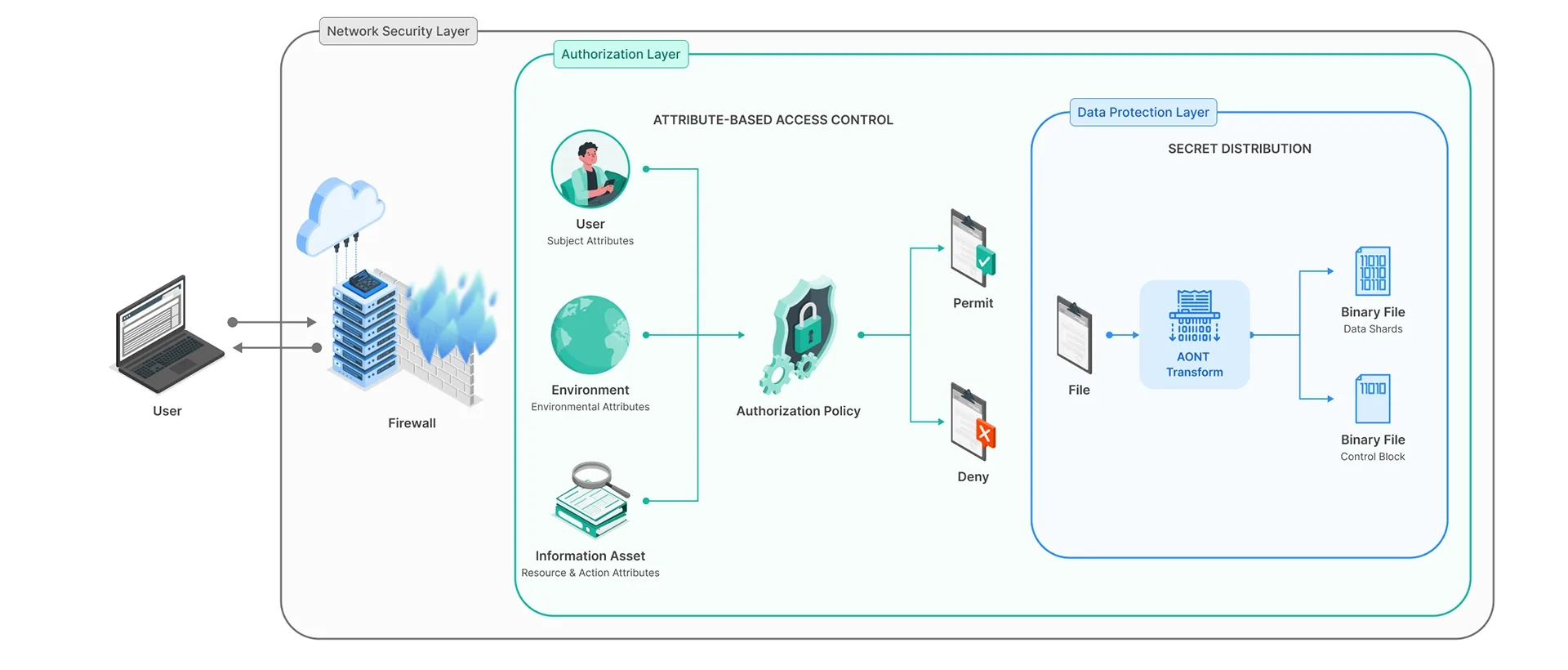
01 Network Security Layer

Control access to the operating environment

Uses network controls to restrict access to the AIKNOW operating environment.

Network isolation and firewall rules are configured as part of the deployment design.

02 Authorization Layer

Evaluate access in context

Attribute-based access control (ABAC) evaluates configured policies using user, environment and information-asset attributes before granting access to requested content.

Policy design supports authorization based on the context of use. Attribute definitions and policy rules are agreed for each deployment.

03 Data Protection Layer

Protect and distribute source text

Separates source-text reconstruction from vector search. Protection from a storage compromise depends on which fragments, components and credentials are exposed.

Source text is protected through secret sharing combined with encryption and stored as fragments across multiple locations. Searchable vectors require separate access controls.

Three-layer security diagram: inside the Network Security Layer is the Authorization Layer (Attribute-Based Access Control: an Authorization Policy is evaluated from User / Environment / Information Asset attributes to decide Permit / Deny), and inside that is the Data Protection Layer (Secret Distribution: a File is split by a secret sharing Transform into Data Shards and a Control Block)

← Scroll horizontally →

From Query to Protected Knowledge

Authorize source-text reconstruction for RAG

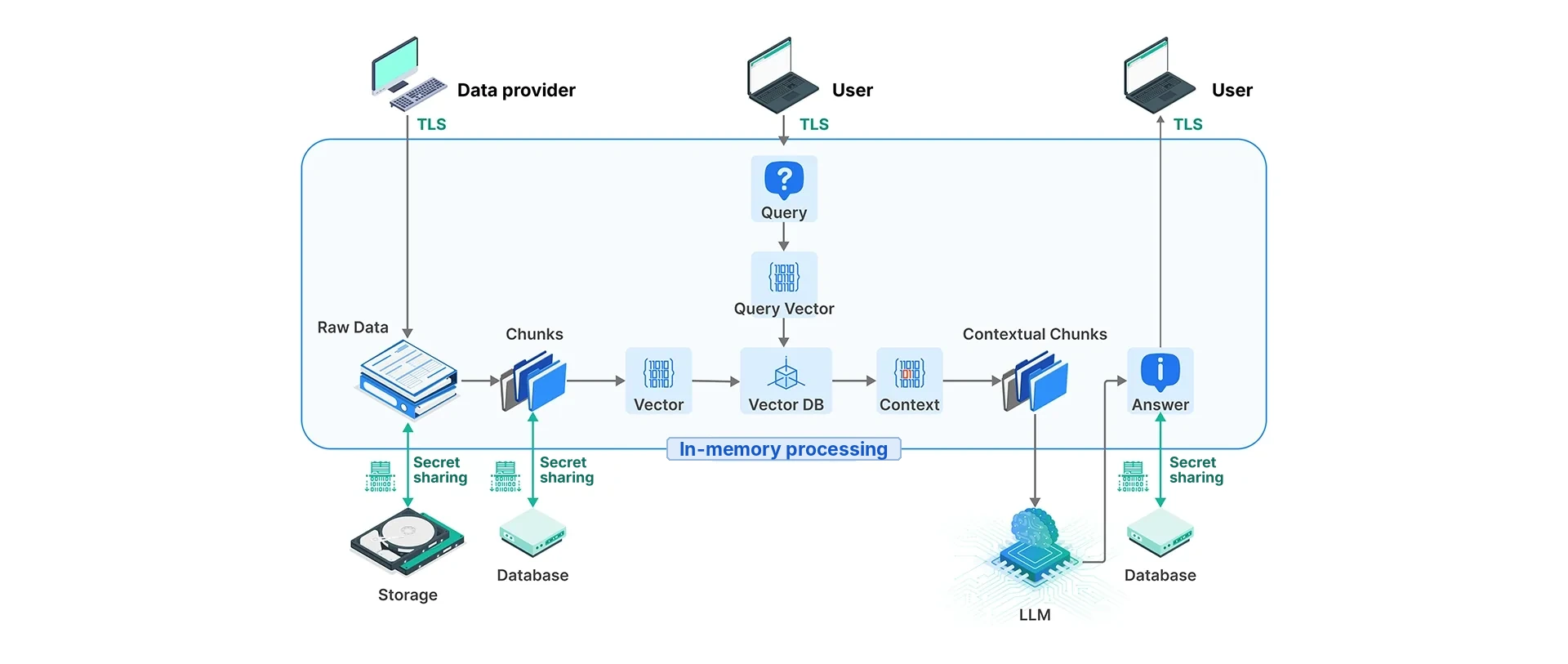
The processing flow checks access policies before reconstructing source text for model context.
The model endpoint and handling of reconstructed content are part of the deployment’s data-flow design.

Protected RAG processing flow: data providers and users connect over TLS, and Raw Data → Chunks → Vector → Vector DB → Context → Contextual Chunks → LLM → Answer is processed in memory, with secret-sharing-based protection for distributed source-text storage; searchable vectors are not protected by secret sharing

← Scroll horizontally →

Step 01

Source data

The original text data to be protected.

Step 02

Chunking

Documents are split into units RAG can use.

Step 03

Vectorization

Vectors are generated for knowledge search.

Step 04

Vector database

Holds the vectors needed for search.

Step 05

Query and search

Relevant context is retrieved for the query.

Step 06

Authorization

Access rights are checked against user, environment and information asset conditions.

Step 07

Authorized reconstruction

The required fragments are retrieved to reconstruct permitted source content.

Step 08

In-memory processing

Reconstructed context is processed in memory. Automatic deletion prevents it from remaining long-term in logs or caches; transient handling still needs to be considered in the deployment design.

Step 09

LLM → answer

Permitted retrieved context is supplied to the LLM to generate an answer. Model hosting and data-handling requirements are configured for the project.

An LLM may run outside your environment. In that configuration, permitted reconstructed content can be sent to the external endpoint; its retention and data-handling policies need to be assessed separately. Secret sharing protects stored source text, not every exposure during authorized processing. Prompt injection, vector and metadata access, and generated answers also require appropriate controls.

Security Maturity

A framework for discussing RAG security controls

Technica AI’s Level 1–5 framework organizes progressively broader sets of RAG security controls.
It is a deployment planning framework, not an industry standard, certification or guarantee of suitability for a confidentiality level.

LEVEL 1

Basic RAG

Vectors and source text are stored as is.

Illustrative starting point
LEVEL 2

Encrypted RAG

AES encryption at rest and TLS for data in transit.

Stored and transmitted data protection
LEVEL 3

Enterprise RAG

Adds RBAC, network isolation and audit logs.

Access and operational controls
LEVEL 4

Confidential Distributed RAG

Separates vectors from source text. Split, distributed storage using secret sharing or similar methods.

Distributed source-text protection
LEVEL 5

High-Assurance RAG

Also integrates confidential execution environments, policy control and governance.

Additional execution and governance controls

AIKNOW Security supports the controls described in Confidential Distributed RAG and High-Assurance RAG, including confidential execution environments. Their deployment and suitability are assessed against the project’s requirements.

Performance

Internal processing-time benchmark

Distributed retrieval and source-text reconstruction add processing steps.
In an internal test, AIKNOW Security’s chunk-level method recorded a processing time close to the tested baseline without distribution.

Internal Latency Benchmark Seconds / processing time (lower is better)
Reference distributed method Reference
30.87
Storage retrieval 28.31 sSecret sharing decoding 0.72 s
AIKNOW chunk-level distributed method AIKNOW
7.27
DB retrieval 0.022 sSecret sharing decoding 0.099 s
No distributed processing Baseline / No Distribution
7.07

30.87 → 7.27 seconds of processing time

Observed processing times in the internal test.

30.87 seconds (reference distributed method) → 7.27 seconds (AIKNOW Security), compared with 7.07 seconds for the baseline without distribution.
Note: Internal test results for the tested configurations; processing times vary by workload and deployment. These figures are not a general latency guarantee.
Use Cases

Plan AI use with confidential knowledge

Confidential Enterprise RAG

Confidential internal knowledge

Apply layered controls to RAG using management documents, R&D materials and customer information. Suitability depends on the data classification, deployment design and operating requirements.

Cross-Department Knowledge

Knowledge shared across departments

Provide retrieval across configured departmental sources while evaluating access policies for each user and information asset.

Authorized source content is reconstructed for use according to configured policies.

Regulated Industries

Finance, healthcare and critical infrastructure

Assess network, access, storage and execution controls against the confidentiality and governance requirements of the intended application. Product capabilities alone do not establish regulatory compliance.

Cloud & Vendor Risk

Managing cloud and vendor dependency risk

Distribute protected source-text fragments across configured storage locations to limit exposure from an individual store. Provider dependencies and risks to other components remain part of the deployment assessment.

TRUSTED ENTERPRISE AI

Design security around
your enterprise knowledge.

Discuss your data classification, model endpoints and access requirements.
We can assess network, authorization and distributed data protection controls for your RAG deployment.

Validate the proposed controls and operating procedures against your project’s requirements before production.

Protect the system.
Protect access.
Protect the knowledge.
Talk to us about AIKNOW Security