


AI-POWERED KNOWLEDGE CREATION

Capture Experience. Build Shared Knowledge.

Draw out tacit expertise through generative AI dialogue—and bring it
into shared knowledge, collaboration and learning.

AISECI provides a framework for putting experience into words and combining it with organizational information. Its 12 capability areas define a target architecture, including development directions. We establish which capabilities can be deployed and which require further development for each engagement.

Socialization Externalization Combination Internalization
Knowledge Management Challenges

Three Barriers to
Sharing and Reusing Knowledge.

Organizations accumulate experience, information, and practical know-how. Making these resources useful across teams requires context, review, and opportunities to apply them.

01

Experience Is Difficult to Share

Experienced staff develop judgment, practical workarounds, and lessons from customer interactions and past failures.

The knowledge that matters most in practice is often the hardest to put into words, so it stays within people’s experience. That makes it difficult to share and pass on, and it risks being lost when people change roles or leave the company.
02

Information Is Fragmented

Relevant information can be spread across documents, email, chat, meeting records, databases, and business systems.

Even when there is plenty of information, if each source is siloed it becomes hard not only to find what you need but also to combine different pieces of information into new insight.

03

Knowledge Is Disconnected from Practice

Manuals and knowledge bases are more useful when teams can find and apply them in their work.

Without feedback and review, documented guidance can drift away from current operating conditions.

Knowledge Creation

The SECI Model of Knowledge Creation

The SECI model describes organizational knowledge creation through interaction between tacit and explicit knowledge. Ikujiro Nonaka presented the theory in 1994; Nonaka and Hirotaka Takeuchi developed it further in The Knowledge-Creating Company (1995).

The model connects shared experience, articulation of insights, integration of explicit knowledge, and learning through practice. AISECI uses these processes as a design framework; the model itself does not establish the effectiveness of an AI implementation.

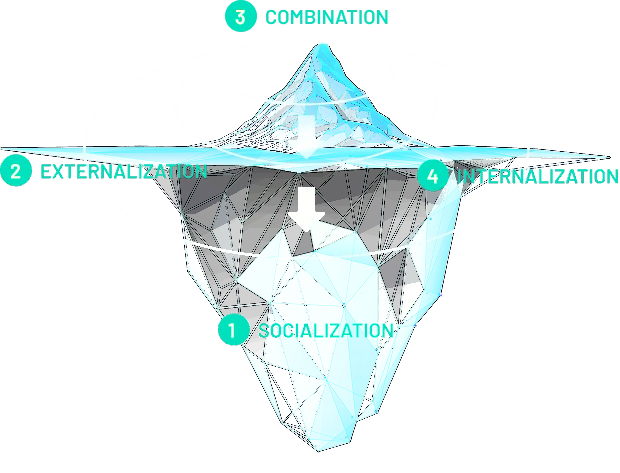
S — SOCIALIZATION

Socialization

Tacit → Tacit

Share experience and pass knowledge from person to person.

E — EXTERNALIZATION

Externalization

Tacit → Explicit

Put experience and judgment into words and turn them into knowledge others can share.

C — COMBINATION

Combination

Explicit → Explicit

Combine multiple pieces of knowledge into more systematic knowledge.

I — INTERNALIZATION

Internalization

Explicit → Tacit

Put knowledge into practice and make it part of your own judgment and skills.

Knowledge Spiral

The Knowledge Spiral

In the SECI model, the four processes interact over time rather than forming a one-time sequence.

Socialization▶Externalization▶Combination▶Internalization

Repeated dialogue, reflection, and practice can contribute to new insights.

The knowledge spiral describes how insights can develop from individual experience into shared team and organizational knowledge. This depends on participation, context, and opportunities to apply what is learned.

IndividualTeamOrganizationSocializeExternalizeCombineInternalize
Conceptual illustration of the SECI knowledge spiral, from individual experience to team and organizational knowledge

Source: Ikujiro Nonaka, Hirotaka Takeuchi, The Knowledge-Creating Company: How Japanese Companies Create the Dynamics of Innovation, Oxford University Press, 1995 (Japanese edition: Toyo Keizai, 1996)

Earlier theory: Ikujiro Nonaka, A Dynamic Theory of Organizational Knowledge Creation, Organization Science 5(1), 1994. The diagrams on this page are conceptual illustrations and AISECI’s capability mapping is a design interpretation.

AI × SECI

AI Support Across the SECI Processes

Human experience, dialogue, and learning remain central to knowledge creation. As organizations grow, collecting and reviewing experience, connecting information, and supporting learning can become harder to coordinate.

AISECI’s target architecture combines human expertise with AI-assisted information processing. The roles below describe the intended approach, with people responsible for validating interpretations, approving guidance, and assessing its use.

Conceptual iceberg illustration: explicit knowledge above the waterline and tacit knowledge below it, with the four SECI processes mapped around the boundary
Generative AI

Help People Articulate Their Experience

Digital tools support the storage and organization of explicit knowledge. Generative AI can also assist with interview prompts, summaries, and comparisons that help people reflect on experience.

Experts can use dialogue to explain observations, decisions, and rules of thumb. AI can help draft these explanations for review, but cannot directly access unspoken experience or fully capture a person’s tacit knowledge.

AI AS CATALYSTSupport dialogue and reflection
Socialization

People Share Experience

Shared work, observation, and dialogue support learning between people. AI-assisted prompts and practice conversations are intended to support these human activities; a simulated dialogue does not replace direct experience with an expert.

Human-led / AI-assisted
Externalization

People Explain; AI Helps Document

The intended approach uses interview prompts and conversation analysis to help experts articulate decision criteria and rules of thumb. AI-generated interpretations and drafts require expert review before becoming shared guidance.

Human knowledge / AI elicitation
AI-ASSISTED PROCESSINGHuman review and oversight
Combination

Connect Reviewed Knowledge

Search, classification, and relationship extraction can help organize explicit knowledge from approved sources. The target design retains relevant source context and access permissions, with proposed changes reviewed before publication.

AI-assisted integration / Human review
Internalization

Support Learning Through Practice

AI-assisted exercises, feedback, and contextual guidance are intended to support learning. People develop skills through practice; training owners assess content quality, and users remain responsible for workplace decisions.

AI-assisted learning / Human practice
Target Architecture · 12 Capability Areas

Twelve Capability Areas for Knowledge Creation

The 12 areas below describe AISECI’s target architecture, not a list of 12 released features. For each engagement, we confirm available components, feasibility, required development, and integration scope before agreeing on delivery.

SocializeExternalizeCombineInternalize010203040506070809101112AISECI12 capability areasTARGET ARCHITECTURE

Select a number to explore its intended role.

Socialization · Tacit → Tacit 01

Expert Persona Simulation

Intended to support practice dialogues grounded in approved expert interviews and documents. Responses would be AI-generated approximations for learning, not statements by the expert or a complete reproduction of their judgment. Source scope and expert review would be agreed during design.

Illustrative Use Case

A Proposed Knowledge Cycle for Sales

This example illustrates how selected capability areas could support sales knowledge sharing. It is not a report of a completed deployment or measured results. Availability, development needs, data access, and evaluation would be confirmed for the engagement.

01 Socialization

Share sales experience

Sales conversations can provide evidence of customer responses, questions, proposal choices, and stated reasons for decisions. Some experience remains unspoken and needs follow-up with the people involved.

In this proposed workflow, Conversation Mining would identify candidate insights for team review. Expert Persona Simulation would support practice dialogues based on approved material, alongside direct discussion with experienced salespeople.

Capability areas illustrated
02 Externalization

Turn experience into sales knowledge

The team would review approved call records and deal histories, using AI-assisted drafts to identify observations and questions for follow-up.

Knowledge Extraction would help participants explain decisions and possible contributing factors. Automated Documentation would draft playbooks, scripts, and FAQs for review. Deal outcomes alone would not establish why a sale succeeded or failed.

Capability areas illustrated
03 Combination

Connect sales knowledge with company knowledge

Reviewed sales guidance could be connected to relevant CRM records, prior proposals, and product information through agreed integrations and access controls.

Enterprise RAG would retrieve supporting information, while the Knowledge Graph would link defined customers, needs, products, and cases. Users would retain access only to permitted information.

Capability areas illustrated
04 Internalization

Use the knowledge in the next sales call

Applying reviewed guidance and reflecting on outcomes can help salespeople develop their skills.

Scenario Exercises would support preparation for customer conversations. An On-the-Job AI Assistant could surface guidance in the agreed workflow; its timing and integration would need validation. Salespeople would review communications and retain responsibility for commercial decisions.

Participants would discuss outcomes and propose updates for review before incorporating them into shared guidance.

Capability areas illustrated

Review new experience and share lessons with the team

Business Value

Three Intended Business Benefits

01

From knowledge held by individuals to organizational assets.

Help teams document experience, decision criteria, and lessons from past work as reviewed, reusable guidance.

The aim is to make recorded expertise easier to share during onboarding and handovers, while retaining access to experienced staff.

02

Knowledge that leads to decisions and action.

Connect relevant sources and make reviewed guidance easier to find within agreed workflows. Usefulness depends on data coverage, integration, and user adoption.

03

An organization whose knowledge grows through work.

Use feedback and documented outcomes to propose knowledge updates. Review and evaluation are needed to keep guidance relevant and assess whether it improves work.

Implementation Planning

Start the knowledge cycle with a single business process.

Begin with one process where knowledge sharing is a clear need. Assess available components and required development, evaluate a defined scope with representative data, and expand only where results and operating conditions support it.

01DISCOVER

Identify critical knowledge and bottlenecks

Analyze the target work to clarify which knowledge matters, who holds it and where the flow of knowledge stalls.

02CAPTURE

Gather experience and existing knowledge

Identify approved documents, records, and expert interviews. Agree on permissions, recording requirements, data handling, and review responsibilities before collection or integration.

03BUILD

Define and Build the Agreed Scope

Select relevant areas from the target architecture and confirm component availability, feasibility, and development needs.

Agree on integrations, acceptance or exploratory evaluation criteria, and human review controls before building and testing the selected workflow.

04EVOLVE

Grow knowledge from real use

Review usage, feedback, and business outcomes against agreed objectives. Validate proposed knowledge or system changes before release.

AISECI

From storing knowledge to circulating it.

From human experience to knowledge.
From knowledge to action.
From action back to new knowledge.

Discuss a focused evaluation of AISECI for your knowledge-sharing needs. We will assess available components, required development, and the scope appropriate to your workflow.

Download

Download

What we will send

    After you submit the form, we will email you a download link. The documents are currently available in Japanese only.

    Loading the form…

    We handle the information you provide in accordance with our Privacy Policy.